Wonders of the Salish Sea 2025 – Schedule
Wonders of the Salish Sea – Schedule 2024
March 18, 7:00 – 7:55 PM.
Why we love the Salish Sea. Jess Newley, Friends of the San Juans
Dive into the Salish Sea and all its wonders with Jess Newley! Visitors and residents come from all over the world to seek out the beauty the Salish Sea provides, from the awe-inspiring moments of humpbacks breaching, the bounty of seabirds cackling at every anchorage, and pods of orcas cruising by… but not many get to experience the underwater world and all of its precious habitats that support the beauty and nature we see at the surface. In this presentation, we’ll explore bull kelp beds, seagrass meadows, and get to know what needs to be protected to sustain the many wonders of the Salish Sea.
Jess Newley is the Community Science and Education Director for Friends of the San Juans. Before working in the San Juan Islands, Jess has been a SCUBA diving instructor in Egypt, taught kids Marine Science from a sailboat in the Salish Sea, and sailed her own boat across the Pacific Ocean doing underwater photography projects. She has a deep passion for the marine environment, boating, snorkeling with salmon, and anything that involves being on or under the Salish Sea. Collecting forage fish samples, educating boaters, teaching kids and engaging community members in conservation and science – her work at Friends of the San Juans combines all of her favorite things.
8:05 – 9:00. The Urban Oceans project: exploring how cities and stormwater influence Vancouver’s coastal ocean. Dilan Sunthareswaran, Natasha Melo Buckiewicz, and Sadie Lye, UBC Pelagic Ecosystems Laboratory.
Vancouver’s coastal waters are surrounded by city life, yet the extent of its impact to ocean health is unknown. We will begin our talk with an overview of some foundational aspects of biological, chemical and physical oceanography relevant to the Salish Sea. We will then summarize the newly launched Urban Oceans Project, a UBC research initiative led by graduate students and researchers from the Pelagic Ecosystems Laboratory. This includes a discussion of current knowledge gaps related to urban oceans, our research objectives and approach, and we’ll highlight some preliminary data from the project.
Dilan Sunthareswaran is a second year Master’s Student at the UBC Earth, Oceans and Atmospheric Sciences (EOAS) department investigating the impact of urbanization on Vancouver’s coastal waters. Dilan is a proud person of colour in science, representing the Sri Lankan community as a member of the Pelagic Ecosystems Laboratory. Dilan hopes his work can educate the general public about Vancouver’s waters and ultimately shine light on our role in shaping the ocean’s health.
Natasha Melo Buckiewicz is a 1st year PhD student in the Pelagic Ecosystems lab at UBC. As a marine ecologist, her research focuses on how the urbanization of Vancouver is affecting the surrounding coastal ecosystems. Specifically, Natasha wants to understand how freshwater and material flows from the urban environment impact phytoplankton, microscopic organisms essential for all marine life. In collaboration with organizations and local First Nations, she plans to help identify the threats related to urbanization to improve Vancouver’s marine environment for marine species and those who rely on their resources.
Sadie Lye is a second year Master’s Student at the UBC Institute for the Oceans and Fisheries studying anthropogenic impacts on Burrard Inlet. Sadie grew up in the Salish Sea and New York City, perhaps explaining why she is interested in Urban Oceans. Through her work, she hopes to contribute to Burrard Inlet and the wider Salish Sea being healthier and cleaner for all its inhabitants, creatures and humans alike.
March 25, 7:00 – 7:55 PM. Qwuloodt estuary restoration project. Melissa Gobin, Michelle Bahnick, Tulalip Tribes.
The 19 square mile Snohomish River Estuary – one of the largest estuaries in the Puget Sound – provides critical rearing habitat and an essential transition zone between freshwater and saltwater for several salmonid populations in the Puget Sound (2005 Snohomish Basin Salmon Recovery and Conservation Plan). Qwuloolt, which is named after our Lushootseed word for marsh, is a part of the Snohomish Estuary that historically held tidal marsh and forest scrub-shrub habitat interlaced by tidal channels, mudflats, and streams. For over 100 years, the Qwuloolt Estuary had been cut off from the Snohomish River and Salish Sea tides by levees, drained by ditches, and characterized by a monoculture of invasive reed canary grass instead of native shrubs and grasses. The levee surrounding Qwuloolt was breached in 2015, allowing salt and fresh water to mix together once again in the ~400-acre site, forming the critical habitat we have today. This session will take you on the historical journey of the Qwuloolt Estuary including why we pursued this project, how the restoration project happened, and findings from current monitoring efforts.
Melissa Gobin is a Tulalip Citizen and the Natural Resource Outreach Education Coordinator. Learning and teaching about the ecosystems of the Salish Sea is Melissa’s passion. She grew up on the Tulalip Reservation and most of her family are involved in Natural Resources. The hatchery is named after her grandfather Bernie Kai Kai Gobin. Tulalip has a rich connection to the Salish Sea and Melissa is one of many Tulalip citizens committed to protecting it. Education and Outreach has given Melissa an outlet to teach kids, adults, and the broader community about the world we live in and the tribe’s longstanding cultural connection to it.
Michelle Bahnick is the Wetland Biologist for the Tulalip Tribes of Washington Natural and Cultural Resources Division. Having started this position in November 2021, they are excited to further develop and refine the Wetland Program to preserve, protect, enhance, restore, and manage wetlands for the benefit of the Tulalip Tribes. Michelle grew up in the Pacific Northwest and has always been fascinated by ecosystems where water and land meet, as well as the connections and interactions between human communities and the ecosystems we live in. Prior to their work with the Tulalip Tribes, Michelle worked in environmental consulting, assisted with studies assessing juvenile salmonid passage through dams on the Columbia River, caught rock iguanas in the Bahamas for a long-term life history study, taught college students how to collect and identify stream benthic macroinvertebrates, and served with the Washington Conservation Corps to restore riparian areas and monitor Aquatic Reserves in Puget Sound. They hold a M.S. in Biology from Western Washington University, a B.A. in Biology from Earlham College, and a certificate in Wetland Science and Management from the University of Washington.
8:05 – 9:00 PM. Unpaving paradise: Kus-kus-sum restoration project. Caitlin Pierzchalski, Project Watershed.
The Kus-kus-sum (KKS) restoration project is a partnership between Project Watershed, the K’ómoks First Nation (KFN), and the City of Courtenay. The project takes place on a former industrial sawmill site in the heart of the K’ómoks Estuary, and aims to restore approximately 4 hectares of tidal marsh and riparian forest, connect to an already protected and conserved area of a healthy estuary area, and rematriate the land back to the traditional stewards of the landscape, the KFN. This presentation will cover the cultural context of the site, the ideation and history of the project, the process of land purchase and transfer, technical development of engineering plans and construction progress to date, along with the ecological restoration processes and monitoring efforts. A field trip to the Kus Kus Sum site will also be offered.
Caitlin Pierzchalski is a restoration ecologist, watershed steward, and experienced program manager. She was born and raised on the traditional territory of the Sylix-speaking Peoples and is currently based on unceded Coast Salish territory. She is inspired by her love of oceans, and has been working in and learning from marine and coastal environments throughout the Salish Sea for the past 10 years. She’s keen to support and further community-engaged stewardship in the Comox Valley that contributes to thriving watersheds, and holds a cautiously hopeful view for the future for our lands and waters.
April 8, 7:00 – 7:55 PM. Crabs and shrimps: their unsung roles in Salish Sea ecosystems. Gregory Jensen, University of Washington
Crabs and shrimps are some of the most familiar (and tasty) denizens of the deep, yet their lifestyles and the ecological roles that they play are often dramatically different from their public personas. I will dispel some of the myths and misconceptions about these fascinating animals and share observations, photos, and video of unexpected and unique behaviors that will change your perception about crustaceans and give you a new appreciation for their varied roles in marine ecosystems.
Gregory Jensen is a biologist and instructor at the University of Washington, and author of several books including “Crabs and Shrimps of the Pacific Coast” and “Beneath Pacific Tides”. An avid diver and underwater photographer, he has spent over five decades studying the marine life of the Pacific Northwest with a particular interest in crustaceans. He lives with his wife Pam (also a crab biologist) and several (mostly) well-behaved turtles in Bremerton, Washington.
8:05 – 9:00 PM. Part 1 – Do Insects live in the salt water of the Salish Sea? Anne Parkinson, Marine Stewardship, Transition Salt Spring.
Insects are ubiquitous – land, freshwater, air, salt lakes, thermal springs – but rarely are they thought of as marine inhabitants. There are a few intrepid insects that have adapted. But do they really live in salt water, or are they interlopers only visiting but not staying for their life cycle? Anne will outline what is known about the unusual insects that make the sea their home, and then focus on the local intertidal chironomid, Paraclunio alaskensis. This fascinating tiny fly weaves a web on the rocky shore as a larva but lives its life as an adult in the air for only one tide cycle. Learn where chironomids fit in the food chain, and how to find them. You will have a new appreciation for the unique adaptive ecophysiology of this small but tough insect that thrives in the rough and tumble salty intertidal zone of the Salish Sea.
Anne Parkinson, MSc, RPBio (ret) is a marine biologist with a 40-year career beginning as a research diver and high school Biology teacher, moving into private sector abalone aquaculture, followed by public sector research officer, and finally 20 years as the University of Victoria Biology Cooperative Education Coordinator. She is the Chair of Marine Stewardship/Transition Salt Spring currently hosting Wonders of the Salish Sea.
Part 2 – The Weird and Wonderful World of Worms. Sheila Byers, Beaty Biodiversity Museum, Nature Vancouver
Sheila had her eyes on marine worms since her teenage years. When rowing ashore near an exposed Atlantic Ocean eelgrass meadow, she observed her first giant clam-worm (Alitta virens) emerging from its burrow. It was huge and she was immediately hooked with both fear and amazement, spending the next 40 plus years as a taxonomist identifying Pacific marine worms, primarily of the Salish Sea. But why would worms attract such attention?
Sheila Byers is a Registered Professional Biologist, Marine Biologist and a long-term volunteer member of Nature Vancouver’s Marine Biology Section, and is part of the WSS planning committee. As well, she sits on the Board of Directors of Marine Life Sanctuaries Society, and currently works at the Beaty Biodiversity Museum (UBC) as the Curatorial Assistant for the Marine Invertebrate Collection.
April 15, 7:00 – 7:55 PM. Why does the Salish Sea glow at night? Carrley Smith, Community Boating Center, Bellingham Bay, WA.
At night in the summertime, the Salish Sea glows when touched. This phenomenon, called bioluminescence, is caused by tiny living organisms at the water’s surface. We don’t know exactly why or how this happens, but we know that bioluminescence is common to creatures worldwide both at the surface and in the depth of the sea. In this presentation, we’ll explore the many mysteries of bioluminescence in the Salish Sea, and how humans have interacted with it for centuries.
Carrley Smith is a recent graduate from Western Washington University in environmental science. As a sea kayak guide, she has led bioluminescence kayaking trips in the San Juan Islands for the past three years. In 2023, Carrley conducted research on bioluminescence in Bellingham Bay as an intern with the Community Boating Center, a non-profit organization that teaches marine stewardship through safe boating. As well, Carrley and colleague Lucy Greeley, have studied with algae researcher Robin Kodner to identify the patterns and species of the bioluminescent organisms that cause this phenomenon. Carrley is excited to share recent research and the natural and human histories of bioluminescence locally and globally.
8:05 – 9:00 PM. The ‘Humpback Comeback’ in the Salish Sea. Tasli Shaw, marine naturalist and artist.
Humpback Whales were once hunted to the brink of extinction along coastal B.C. However, the banning of commercial whaling gave them a second chance in these waters, and now they are back! But who are these whales anyway? What mysteries do they keep, and what does the future hold for them in the Salish Sea?
Tasli Shaw has more than 13 years’ experience working on the Salish Sea as both a captain and wildlife guide. In addition to managing the Humpback Whales of the Salish Sea project, she also works as an analyst for Department of Fisheries and Oceans Canada, assisting with both the long-standing Bigg’s Killer Whale monitoring program (in collaboration with Bay Cetology) and the CeMoRe project. When not contributing to research projects, she spends time in the studio, creating elaborate illustrations about the creatures who call the coast home.
Fieldtrips (so far)
- Vancouver, BC. Intertidal Exploration: Seaweeds and Invertebrates. April 27, 2024, 1:00 – 3:00PM. We are excited to have Dr. Bridgette Clarkson back to introduce us to the common seaweeds that thrive near the entrance to Vancouver Harbour at this time of year. As well, Sheila Byers, Beaty Museum; Sharon Adelman, Vancouver Aquarium volunteer; and Alyana Lalani, UBC student, will be our guides as we explore the intertidal zone to discover the diversity of invertebrate life found there. We will gather at 1:00PM near The Fox’s Den (Spray Park), north of the Vancouver Aquarium. A good low, low spring tide (LLW) will occur at 14:49 at an elevation or height of 0.7 m (2.2 ft). The field trip will proceed regardless of weather, so dress accordingly (water, snack, warmth, rain gear, waterproof footwear). This is always a fun day of exploration so expect to be surprised and learn something new!
- Courtenay, BC. Kus-kus-sum site visit with Project Watershed. April 4, 3:00 PM. More info to come.
- San Juan Island, WA, Friends of the San Juans. More information to come.
- Salt Spring Island, BC, Marine Stewardship, Transition Salt Spring. More info to come.
WSS Field Trip, 2023
Wonders of the Salish Sea 2023 Field Trip, Vancouver, BC
Intertidal Exploration at Stanley Park
Partnership with Nature Vancouver
Report by Sheila Byers, member of the Wonders of the Salish Sea planning committee and Nature Vancouver’s Marine Biology Section
What a day of intertidal exploring we had on Saturday, May 6, 2023! Spring tide low water level (LLW): 13:13 at 0.6 m elevation. The forecasted rain was just a sprinkle making our trip quite comfortable, albeit cool under an overcast sky. Fifteen participants arrived early at 12:15 pm to the Lumberman’s Arch area to sign the Liability Waiver forms. Keeners from both Wonders of the Salish Sea and Nature Vancouver attended. Three hours later, the hangers-on begrudgingly departed at 15:30!

The unique combination of leaders provided a wonderful holistic approach to intertidal exploration: Wonders of the Salish Sea (WSS)—trip coordinator Deborah Simpson; Nature Vancouver Marine Biology Section—Marine Biologists and experienced field guides Sheila Byers and Joan Lopez; and special invited guest and seaweed guru—Dr. Bridgette Clarkston, UBC Professor.

Our destination goal: the large boulder area off Figurehead Point before the tide changed direction. First on the agenda: resolve the WSS Chat question noted in the April 3 WSS program presentation: At a beach that you often frequent, if you stood in the middle of the intertidal area at high tide, would your head be above or below the water? Answer: we stood in the sandy mid-intertidal beach looking southward towards the north-facing rock seawall. In Stanley Park, the gradual slope of the intertidal towards the forested upland is shortened by the hardened edge of the seawall. Nonetheless, the seawall provides habitat for marine life adapted to the upper intertidal, covered during the high tide. Even with height variation of participants, a high tide would cover our heads. In this somewhat protected bay, the slope of the beach is quite gentle. Would the result be the same on a steeply sloped beach on the west coast of Vancouver Island?
Within a short distance, we were attracted to a distinct growth of green seaweed that fanned out from the outflow of an upland stormwater pipe draining into the mid-intertidal area. Bridgette identified a species of green sea lettuce, cornrow or sea hair sea lettuce (Ulva intestinalis). This tubular seaweed, often associated with freshwater seepages, is the most common species found growing on rock all over the world (cosmopolitan species).

Near the low water edge of the sandy beach a half-buried rock presented an array of large seaweeds. Bridgette took the opportunity to introduce the three major groups of seaweed categorized by colour: the greens, reds and browns. It seems straight-forward, but interpreting colours can be tricky especially between the reds and browns.
The cornrow sea lettuce noted earlier was an example of green seaweed, a colour we generally associate with land plants. Green seaweeds have chloroplasts that contain the green pigment, chlorophyll. Chlorophyll captures the energy of the sun that is necessary for photosynthesis. It was a green seaweed that some 400 million years ago, ‘invaded’ land and evolved into our land plants.

A large specimen of Turkish towel (Chondracanthus exasperatus) provided an example of red seaweed. Red seaweed contains the phycoerythrin pigment but seaweed colour can vary from deep wine reds to purplish pink. Dark red variations, in particular, can present difficulties distinguishing dark brown seaweed. Note the bumpy surface (papillae) of the towel that gives the seaweed its rough texture and human interest to use this ‘towel’ as a handy skin scrub.
Bridgette was surprised to see so many young bull kelp (Nereocystis luetkeana) attached to the rocks in the intertidal sandy area. Bull kelp are a good example of brown seaweed, that with the presence of the fucoxanthin pigment, can vary in colour from yellow/light brown to dark brown. Less than a metre in length and located in the mid to lower intertidal zone, she predicted that the young subtidal kelp would not survive long there due to the lengthy low tide exposure to the sun and heat. Capable of growing to great lengths of 10-35 m annually, the bull kelp is adapted to subtidal depths with a single float that keeps the blades near the surface for photosynthesis.
The young bull kelp provided ideal specimens from which to describe the holdfast, stipe, float, and blades. The tips of the blades are where the reproductive patches of spores (sori) are produced. Bull kelp is an annual seaweed. Imagine this kelp growing to such lengths in just 6-7 months!!
Kelp is a term used to describe the large brown seaweed.

As we progressed towards the rocky Figurehead Point, we were overwhelmed by the extensive expanse of brown kelp including bull kelp, sugar wrack (Saccharina latissima) and the broad-winged kelp (Alaria marginata). Bridgette reminded us that all kelp is seaweed but not all seaweed is kelp!
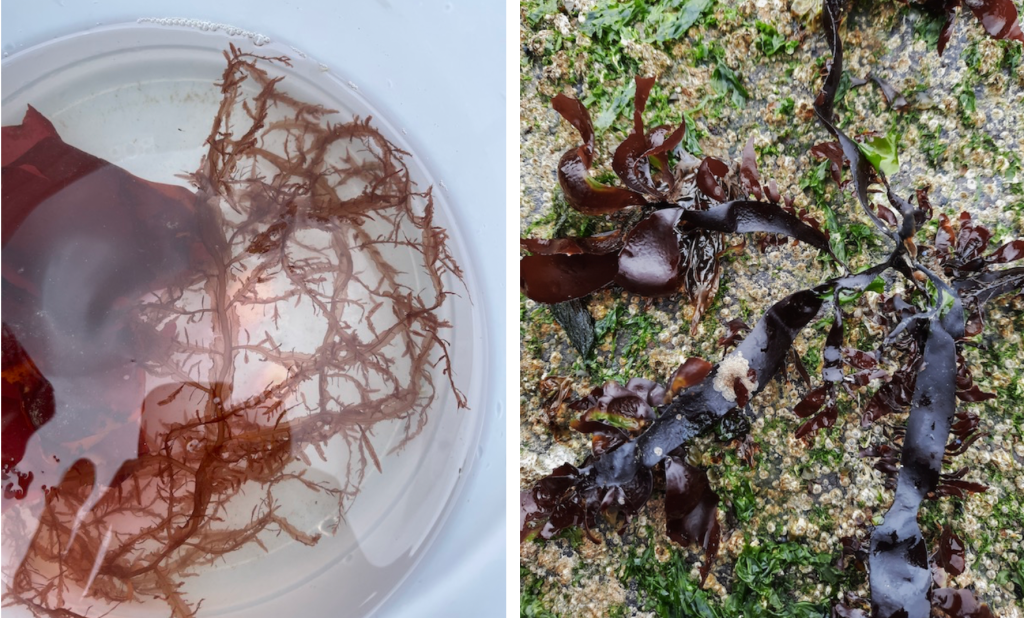
Along the way to the point, two unusual red species were discovered, although neither was attached. One, a delicate pale red, flat blade with a conspicuous midrib and feathery side branches is known as the winged rib, (Cumathamnion decipiens). Curiously, it is so fragile that if mishandled (becomes too warm), it will bleed its red pigment! The second, a flattened and tough, thick-bladed bleach weed (Prionitis sternbergii) releases a bleach-like smell when squished that is thought to be a chemical defense against grazers. The latter species is not unlike the acid weeds with regards to the production and use of chemicals (sulfuric acid). The sulfuric acid stored in the acid weeds will digest anything with which it comes in contact!! Both of these algae are found in the lower intertidal area and a first record for many of us frequenting the Figurehead Point area.
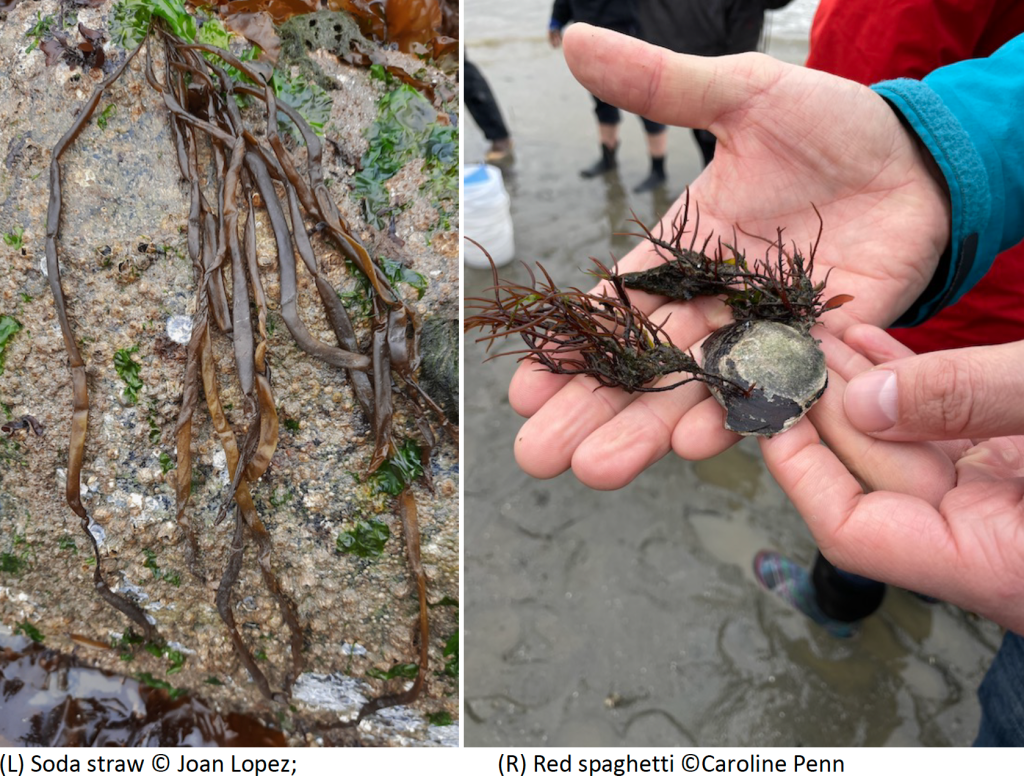
A much smaller brown seaweed looked like well-used paper straws: unbranched hollow tubes that had constrictions at more-or-less regular intervals. This golden-brown seaweed is known as the soda straw (Scytosiphon lomentaria). The soda straw is a strong contrast to the multi-branching red seaweed attached to the shell. The latter red spaghetti seaweed is a Gracilaria species that is part of a complex of difficult species to identify. As Druehl and Clarkston state of Gracilaria in their 2016 book, the complex of species appears to be distinguished by a lack of distinguishing features – at least, none that are morphological(describing the form of living organisms). So much to learn!!
The seaweed growing at Figurehead Point is beautiful, bountiful and astounding. And this diversity is reinforcing, given its location within the busy industrial harbour of Burrard Inlet. Thankfully, the inlet is not the polluted harbour of its historical past.
But WAIT! What about marine invertebrates?!?!?! Normally when Joan and/or I lead intertidal explorations, we focus primarily on the diverse intertidal invertebrates.

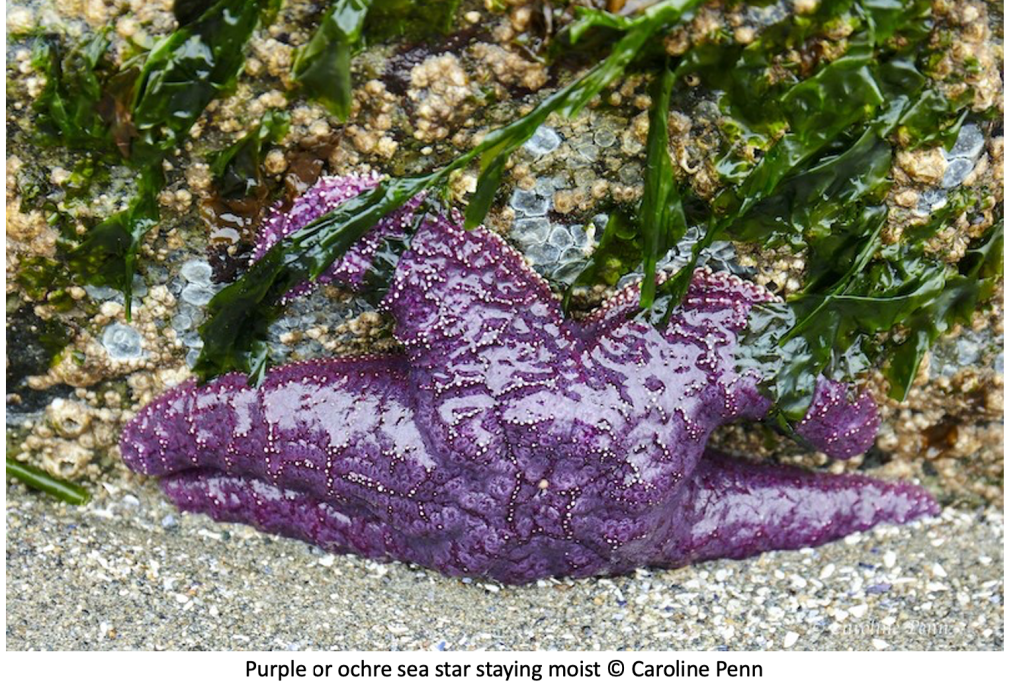
An important news report is that a good number of purple or ochre sea stars (Pisaster ochraceous) continue to be found hunkered down under the north-facing base of many of the large boulders. A few unhealthy-looking individuals were found ‘out in the open’. Was this a sign that the sea star wasting disease syndrome was still present; or did these few individuals succumb to the persistent pecking of the hungry sea gulls and crows? Considering the health of the majority of the purple stars it was likely the latter. Healthy looking leather stars and mottled stars were also found, evidence of a promising recovery of these species of sea stars. However, the survival and recovery of the affected sunflower star (Pycnopodia helianthoides) remains uncertain.

Apart from the usual butter clams, fat gapers and heart cockles, an obvious increase in the abundance of the introduced Pacific oyster (Magallana gigas) was very noticeable this year! Is this because they are better adapted and more at home in the warmer water brought by climate change? Also, however, the abundance of the native frilled dogwinkle (Nucella lamellosa) seemed to increase over observations of previous years. It is tempting to consider that the predatory dogwinkle may prove beneficial as a natural control of the prolific oysters.
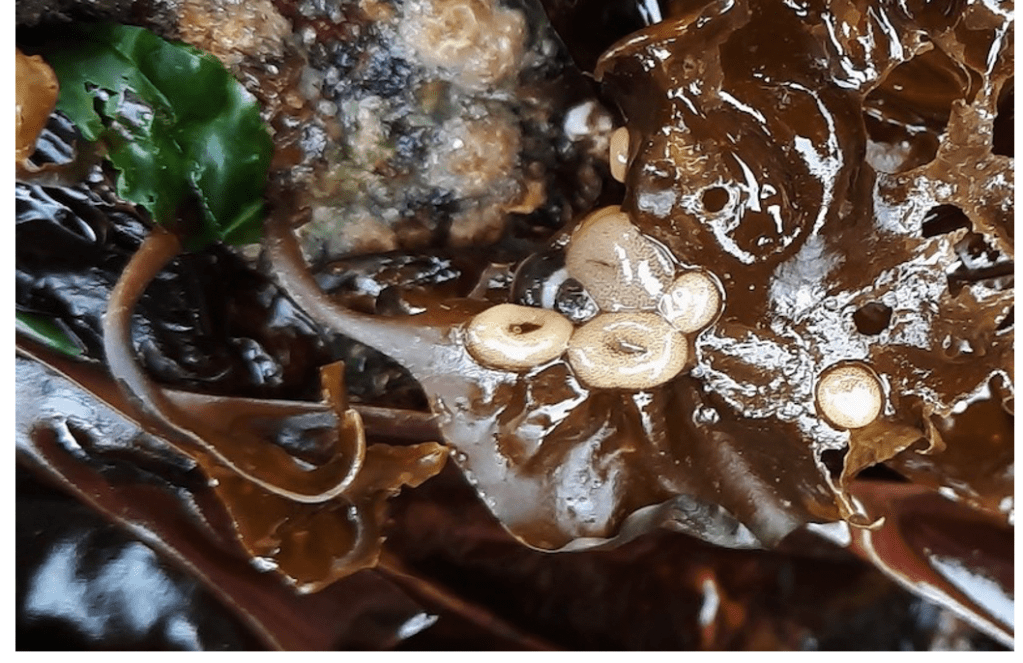
Someone’s sharp eyes saw a very cool and rare-to-find cluster of tiny yellowish, donut-shaped egg sacs. These distinctive shaped egg sacs were likely deposited by the wide lacuna, Lacuna vincta. Obviously, the early spring is the time not only for growth of algae but for lots of reproductive action for the intertidal flora and fauna!

It is not just large marine life that live in these productive intertidal areas. There are many smaller organisms that hide beneath the seaweed or under rocks. A scale worm (bristleworm or polychaete) was found with its paired scale-like elytra clearly overlapping and covering its back. Even a green urchin, (Strongylocentrotus droebachiensis) was located under a flat rock. Its larger size indicates a good feeding supply relative to the smaller sizes (~1 cm) observed last year. Alternatively, it’s growth could be a direct result of the demise of a major predator, the sunflower star, normally found off Figurehead Point.

To the delight of everyone, another overturned rock revealed a fish trying to hide and keep moist through the low tide period. The frightened, wiggling fish had a broad orange/red tail fin and the rest of the body also appeared red. But other defining markings were more difficult to observe. My attempt to identify the fish landed on the Red Gunnel (Pholis schultzi). In retrospect and in reviewing the description and image of this fish, I am less confident with this identification. I now wonder if it might be a longfin gunnel (Pholis clemensi). Such arises the problem with using only colours for species identification. Since I am not a fish specialist, I am afraid that the name of the mystery fish remains unknown. Perhaps another visit to Figurehead Point is necessary, accompanied by an ichthyologist, to clarify the identity of this illusive fish.
All in all, a rich diversity of organisms was found during the field trip to the sandy beach and rocky Figurehead Point area of Stanley Park. The low spring tides are such an excellent time to explore any intertidal area and we were not disappointed. The combined focus on algae and marine invertebrates made for a very informative and interesting day. With all the foot traffic that this Stanley Park beach gets throughout the year, I continue to be amazed at the survival resiliency of its biodiversity.
Thank you to all the contributors, photographers and enthusiastic participants.
Resources:
- Andy Lamb and Phil Edgell. 2010. Coastal Fishes of the Pacific Northwest. Revised and Expanded Second Edition.
- Louis D. Druehl and Bridgette E. Clarkston. 2016. Pacific Seaweeds. A Guide to Common Seaweeds of the West Coast. Updated and Expanded Edition.
- Mandy R. Lindeberg and Sandra C. Lindstrom. 2010. Field Guide to Seaweeds of Alaska. Alaska Sea Grant
- Sandra C. Lindstrom. Brochure
- Wonders of the Salish Sea Programs: https://wondersofthesalishsea.com/
Wonders of the Salish Sea
Reply
Enjoy this video called “Howe Sound Ballet”, showing a glimpse of the wonders of the Salish Sea.
 Wonders of the Salish Sea